Blog
Best DJ Lights for a Mobile DJ Setup: A 2026 Buyer’s Guide
Sep
If you’re building out a mobile DJ rig, lighting is usually the last thing you budget for and the first thing your dance floor notices. The right setup turns a plain room into an event; the wrong one is a pile of gear that’s heavy to haul, slow to set up, and doesn’t look like much once it’s on. Here’s how to think about building a lighting rig that actually works for mobile gigs — weddings, house parties, bars, and everything in between.
What Makes a Light “Mobile-DJ Friendly”?
Not every light built for a permanent club installation makes sense for a rig that gets packed into a car every weekend. Before you buy anything, weigh each fixture against four things:
- Setup speed. You want lights that clamp to a truss or stand and power on in minutes, not fixtures that need a rigging crew.
- Weight and footprint. If you’re loading in solo, a light that’s easy to carry in one trip beats one that technically looks better on paper.
- Control flexibility. Look for fixtures that offer both sound-active mode (plug in and go) and DMX control (for when you want a programmed show). We break down the difference in our guide to syncing lights to music.
- Versatility. A fixture that can do beams, wash, and a few gobo patterns covers more room types than a single-effect light.
The Core Fixture Types Worth Having
Most mobile DJs end up building their rig around a mix of the following. You don’t need all of them on day one, but each covers a different job.
Moving Head Lights
Moving head lights are the workhorse of a mobile rig. They pan, tilt, and throw beams or wash light across a room, which means one or two fixtures can cover a space that would otherwise need several static lights. They’re a strong first purchase because they scale from a small living room to a mid-size reception hall.
Party Lights & Multi-Effect Fixtures
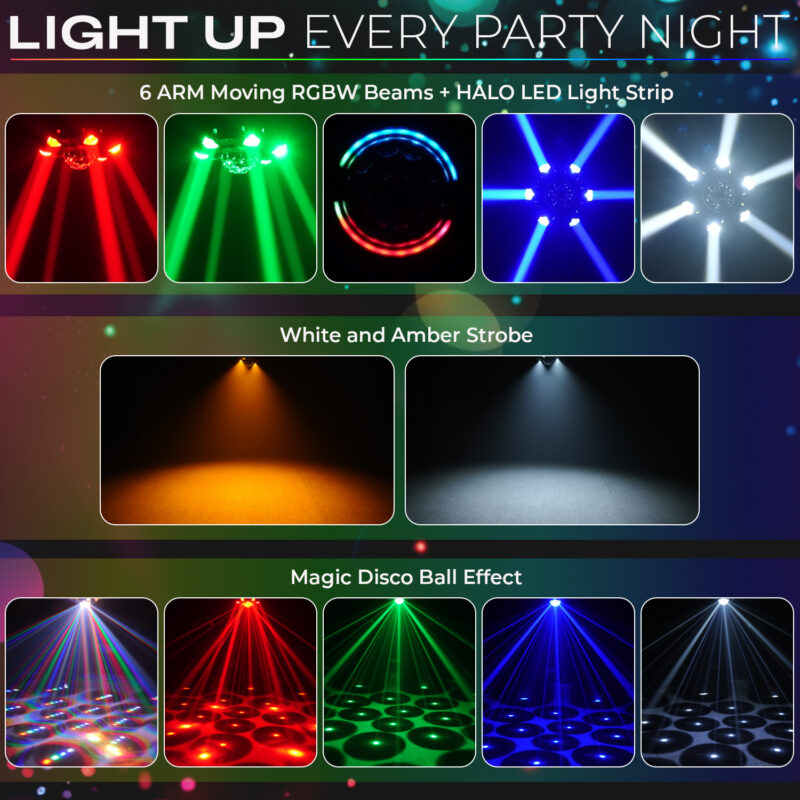
All-in-one party lights combine several effects — beams, lasers, strobe, sometimes a projection pattern — into a single compact unit. These are the easiest fixtures to justify for a starter rig because one light does the work of three, and most run in sound-active mode straight out of the box.
Strobe Lights
Strobes aren’t a full-time fixture — they’re a moment-maker. Save them for drops, countdowns, and high-energy peaks. See our full moving head vs. strobe comparison for how to split time between the two.
Animation Lasers
Laser lights add graphics, text, and aerial beam patterns that other fixtures can’t replicate. They read well from across a room, which makes them a good pick once your rig has outgrown the basics.
Disco Ball & Projection Lights
A disco ball fixture or LED projection light is inexpensive ambiance — great for filling wall and ceiling space at low cost, especially for house parties and smaller venues where a full moving-head rig would be overkill.
Fog Machines
Not a light at all, but a fog machine is what makes beams from moving heads and lasers actually visible in the air instead of just hitting the wall. If you’re investing in beam-heavy fixtures, a compact fogger is worth the extra bag.
How Many Lights Do You Actually Need?
This is the question that trips up most new mobile DJs — more lights isn’t automatically a better show. A rough guide by venue size:
- House parties & small rooms: One or two multi-effect party lights plus a disco ball fixture is usually plenty.
- Weddings & mid-size venues: Two moving heads for beam coverage, one multi-effect fixture for fill, and a fogger to make the beams pop.
- Bars, clubs & larger stages: Four-plus moving heads, dedicated strobes for drops, and at least one laser fixture for aerial effects.
Start smaller than you think you need. It’s easier to add a fixture between gigs than to have paid for gear that never leaves the case.
Budget Priorities: What to Buy First
If you’re building the rig in stages, this is the order that gets you the most visible impact per dollar:
- One or two moving head lights (your main beam coverage)
- A multi-effect party light (fills gaps, doubles as backup)
- A compact fogger (makes everything above look better)
- A strobe for high-energy moments
- A laser once you want more range and aerial effects
Quick Setup Checklist
- Test every fixture and DMX/sound-active mode at home before the gig, not in the venue parking lot
- Pack a spare set of clamps and safety cables — venues rarely have extras
- Bring a power strip with more outlets than you think you need
- Label your DMX cables if you’re running more than two fixtures together
Ready to start building your rig? Browse the full DJ lighting collection or jump straight to our moving heads and party lights.
