Blog
DMX Lighting for Beginners: How to Set Up Your DJ Lights With DMX Flashback Events
Nov
DMX sounds technical, but the basics fit on one page. This beginner guide shows you how to set up DJ lights with DMX Flashback Events, our light show app for mobile DJs and party hosts: what you need, how to connect and address your lights, how to get your first looks going, and how to keep lasers and fog safe. Every step here matches what is in the app today. For a quick summary first, see the overview.
Free during the beta: DMX Flashback Events, including the Mac helper, is free to use while the app is in beta.
What Is DMX, in Plain Words?
DMX is the language DJ and stage lights use to take orders. A controller sends a stream of numbers down a cable, and each light listens to its own small block of those numbers: one for brightness, one for color, others for pan, tilt, strobe and so on. Those numbers are called channels.
- Address: the first channel a light listens to. You set it on the light’s own display, then type the same number into the app.
- Channel mode: how many channels a light uses, for example 24CH or 26CH. The light and the app must use the same mode.
- Universe: one full set of 512 channels. One EasyNode is one universe, which is plenty for a mobile DJ rig.
- Daisy chain: the DMX cable goes from the interface into the first light, then light to light.
Want more background? Read Sound-Active vs. DMX Explained.
What You Need
- A Mac with macOS 11 or later, Apple silicon or Intel.
- The DMX Flashback Events helper, a free download from inside the app. It sends the show to your lights.
- A DMX interface: a USB-DMX plug, or a Wi-Fi box such as the Pknight EasyNode that speaks Art-Net. You can use both at once.
- DMX lights, like the Flashback moving heads listed below, plus DMX cables.
- Optional: a phone or iPad for the Live view and remote, a MIDI controller or Stream Deck, and a fog machine or hazer.
Step 1: Install the Helper and Open the App
- Open dmx.dancepartylights.com and tap Connect lights, then Download for Mac.
- Open the zip and drag DMX Flashback Events to Applications. Double-click it.
- First time only: if the Mac says it can’t check the app, click Done, open System Settings → Privacy & Security, scroll down and click Open Anyway.
- If it asks to find devices on your local network, click Allow. That is how it finds a Wi-Fi DMX box like the EasyNode.
- Click Open Lights app in the helper. Your lights and stage come with you, and it works without internet.
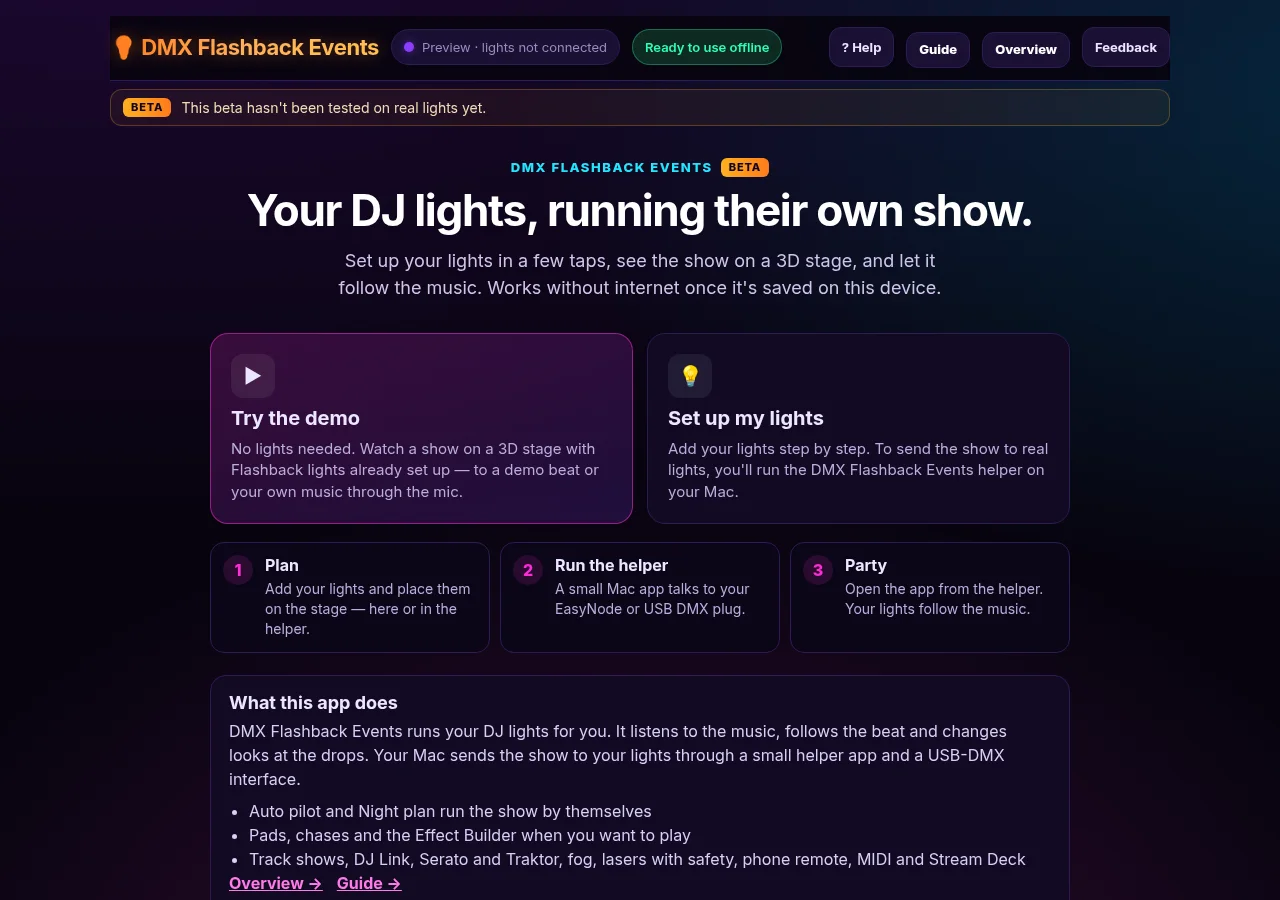
Want to look around first? Tap Try the demo on the start screen to see a show on a 3D stage with no lights plugged in, then tap ? Help → Show me around for a short tour.
Step 2: Add Your Lights and Set Their Addresses
- Plug the DMX cable from the interface into the first light, then light to light.
- In the app’s setup, pick your interface. The helper shows DMX interface: connected when it is found.
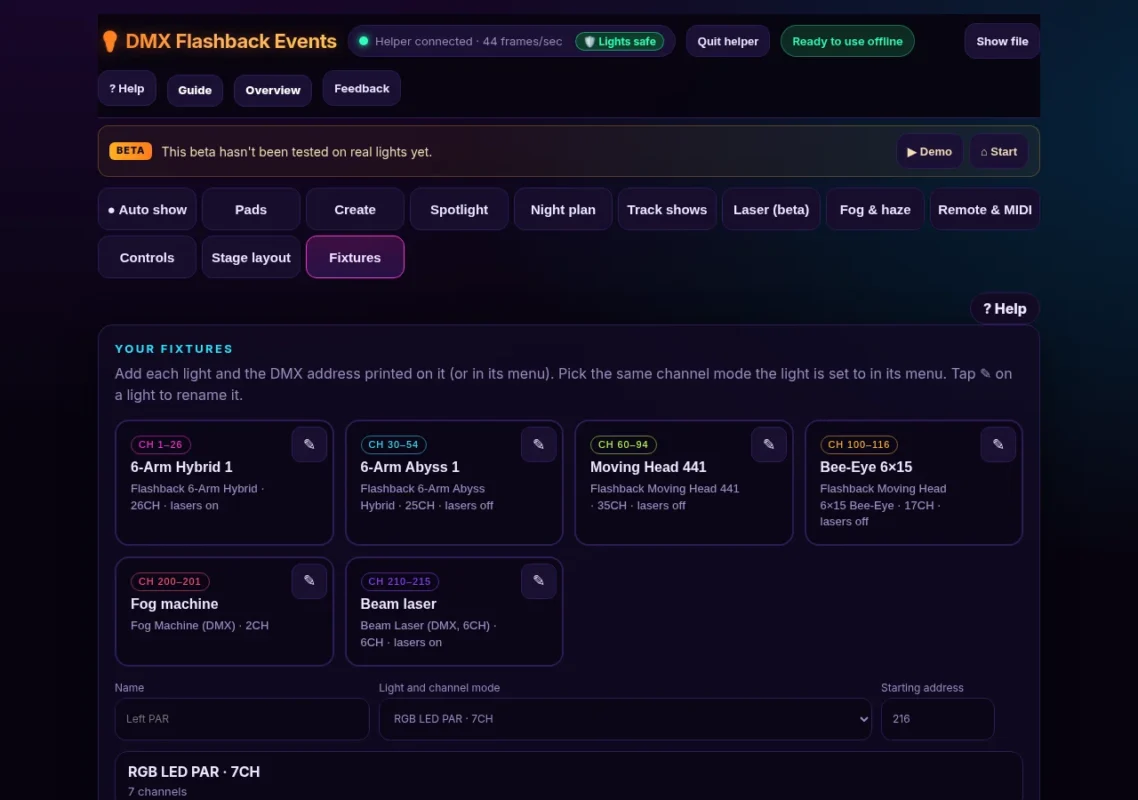
- Add each light and pick the channel mode it is set to (for example 6-Arm Hybrid, 26CH).
- Type the DMX address shown on the light’s own display. Lights must not overlap. The app warns you if they do.
- Use Find to flash one light at a time and check you have the right one.
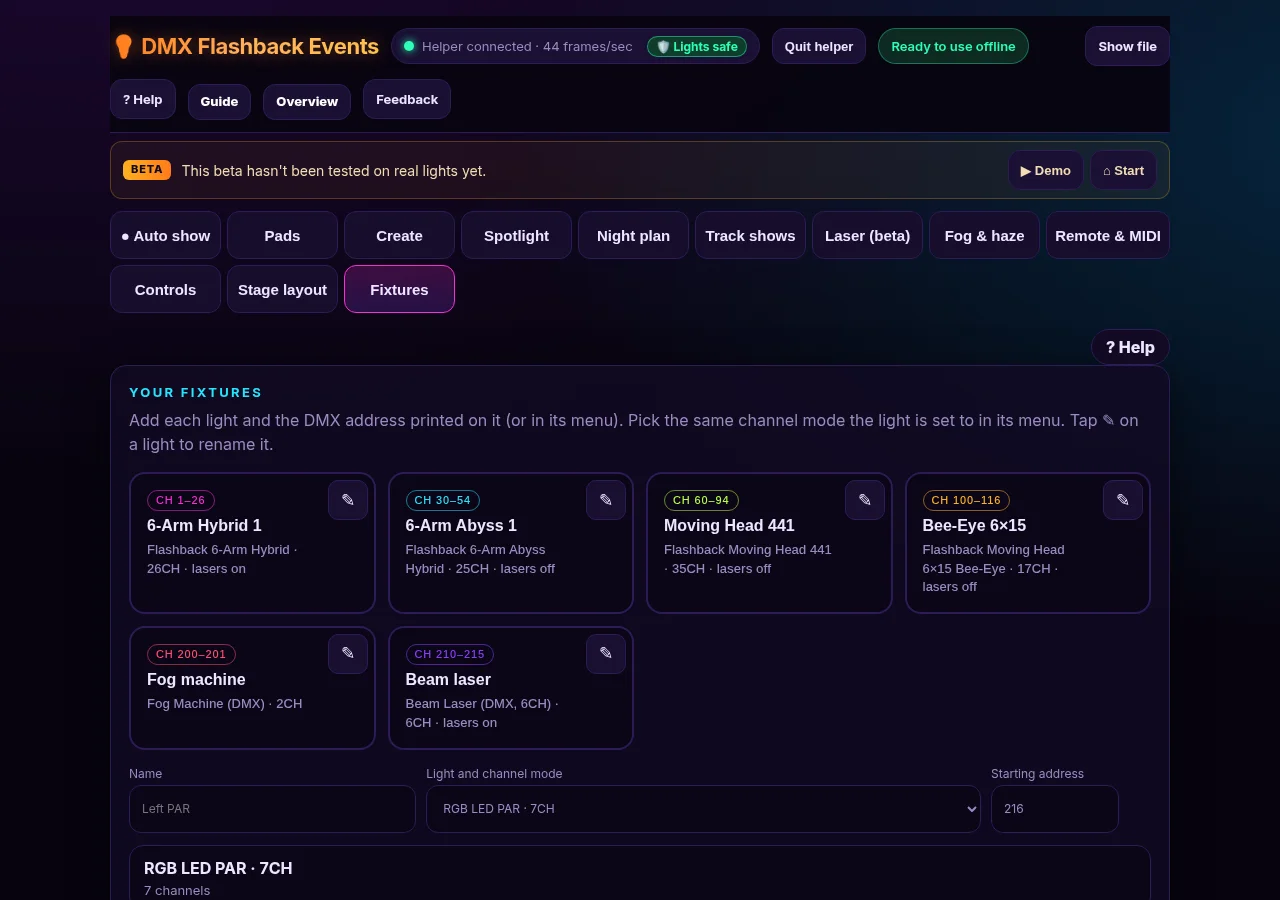
Our Flashback lights are built in (6-Arm Hybrid and Abyss, Moving Head 441, Bee-Eye 6×15), plus generic pars, dimmers, moving heads, fog machines, hazers and DMX lasers. For another light, open Fixtures → Import a profile and pick a grandMA2 (.xml) or Avolites (.r20 / .d4) file from the maker, then check its channels in the profile editor.

Step 3: Your First Looks With Auto Pilot and Pads
The quickest way to a good show is to let the app drive. Turn on Auto show on the first tab and the lights follow the beat. Auto pilot picks the mood from the music (chill, party or peak), changes the look every few phrases, and calms down for speeches.
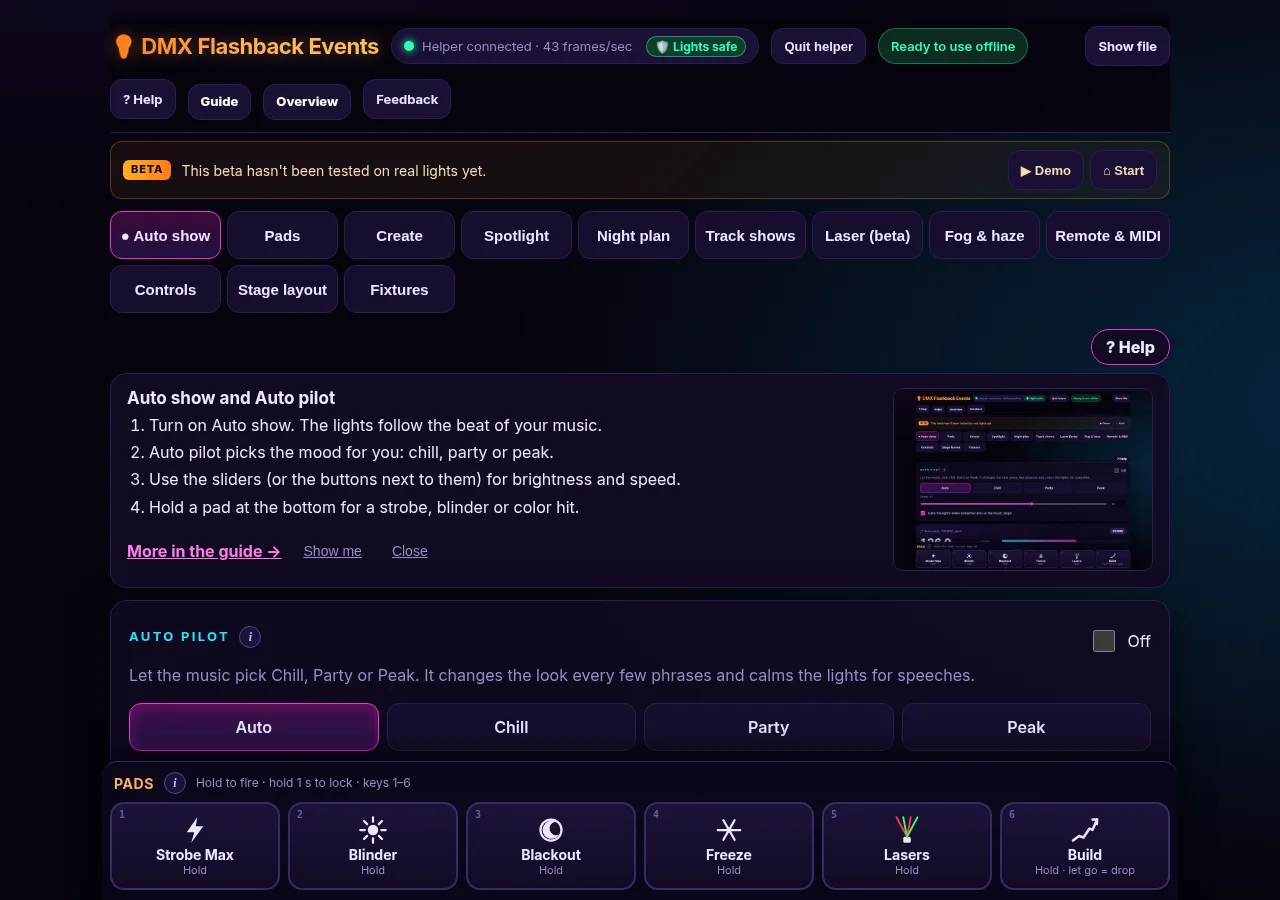
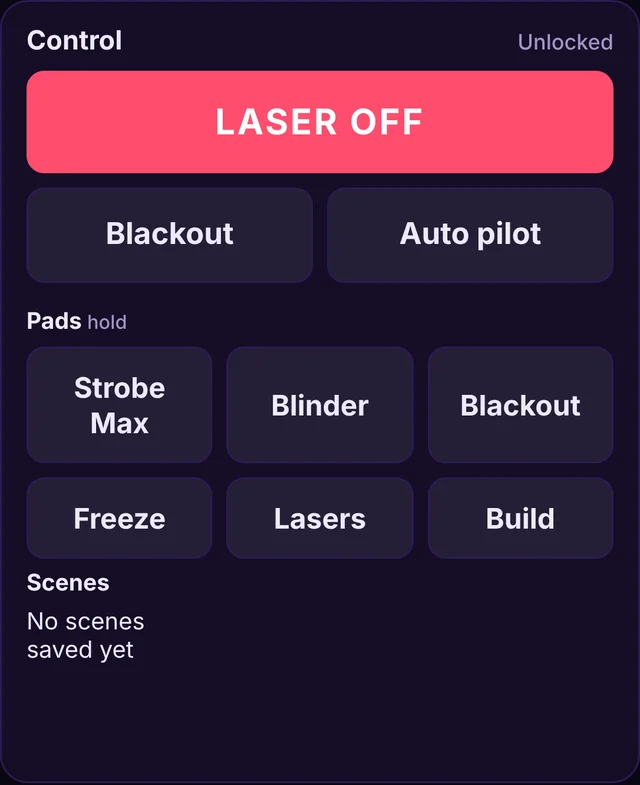
When you want to play along, use the pad bar at the bottom of every screen. Hold a pad for a strobe, blinder, blackout or laser hit, and let go to return to the show. Hold for one second to lock it on. Keys 1 to 6 work too.
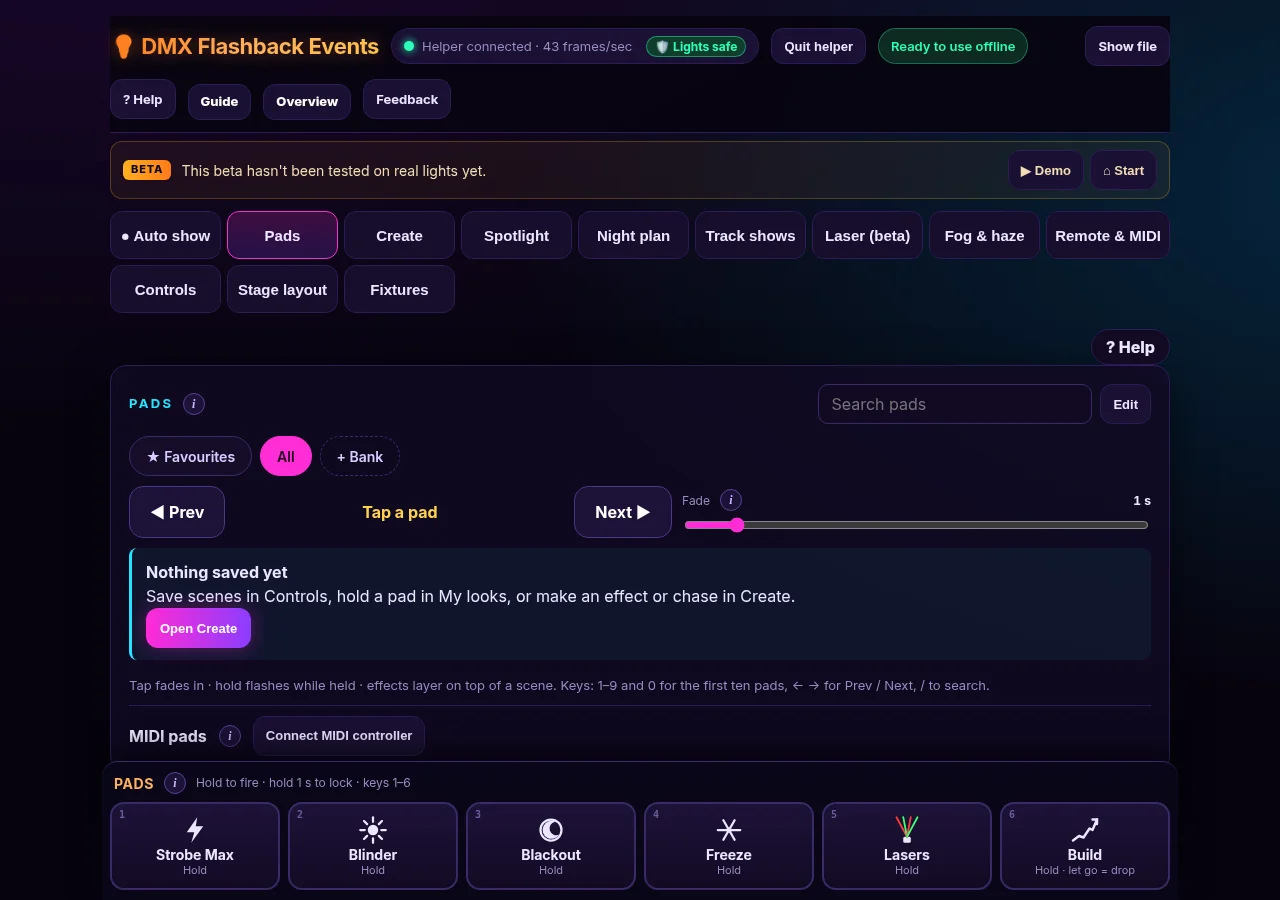
- Make my looks builds a set of looks for your lights in one tap.
- Scenes: save what you see and tap it to bring it back.
- Chases: put scenes in a row and they step on the beat.
- Effect Builder: on the Create tab, pick an effect (wave, color chase and more), choose the lights or groups, and drag the sliders.
- Night plan: add the moments of your night (dinner, first dance, party, last song) and tap Next when each one comes.
Your lights’ own auto, sound and reset programs are never triggered by shows, sliders or pads, so a show can’t make a light do something unexpected.
Step 4: Set Up the Room and Aim Your Moving Heads
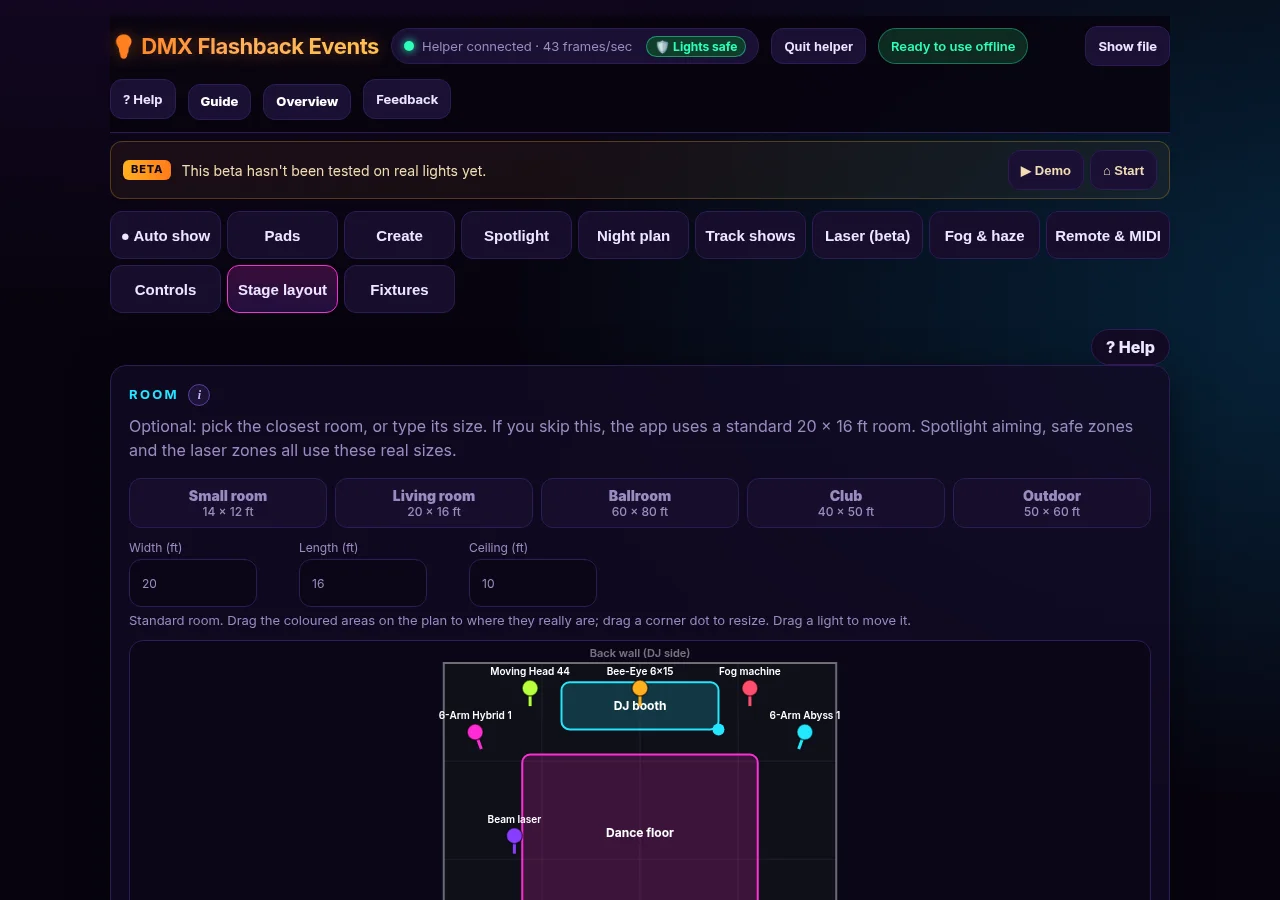
- Open Stage layout and pick a room size, or type your own.
- Drag each light to where it really stands. The 3D view shows what the guests will see.
- Pick how each light is mounted: on the floor, on a truss, or hanging upside down, so moving heads aim the right way.
- Use Point check to make sure a moving head really points where the app thinks it does.
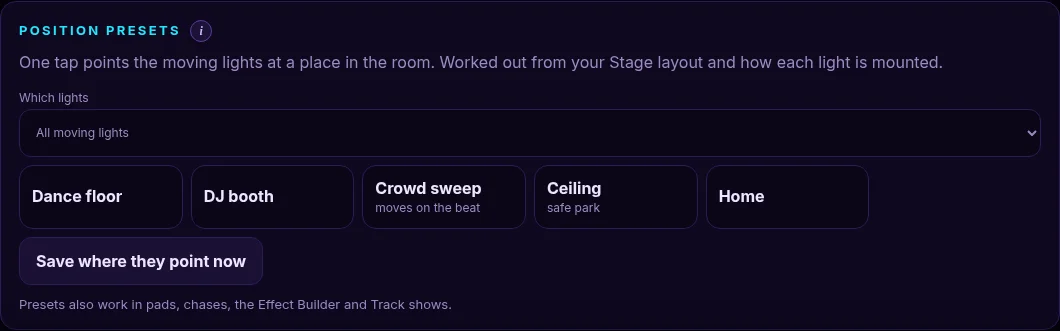
- On Spotlight, use position presets like Dance floor, DJ booth, Crowd sweep, Ceiling and Home, or save your own.
Step 5: Safety Basics for Lasers and Fog
Lasers
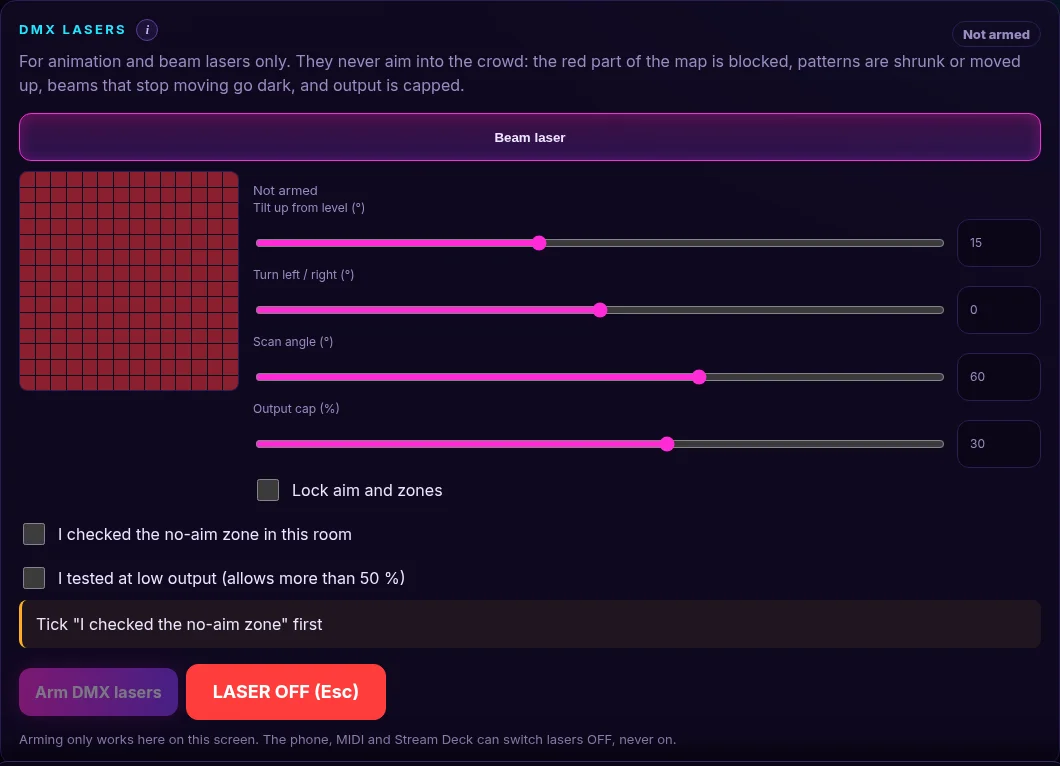
Lasers can hurt eyes. Follow the rules where you play, and keep these basics in mind:
- Never aim a laser at people. Beams stay above the safe height, 3 m (about 10 ft) by default, so set the room height honestly.
- Start at low power. The app caps power until you tick tested at low power.
- Only you can arm a laser, on the DMX Flashback Events screen. MIDI, Stream Deck and the phone can switch lasers off, never on.
- LASER OFF at the top of the screen and the Esc key stop every laser at once.
- DMX beam and animation lasers also get a no-aim zone over the crowd and a beam that blanks if it stops moving for one second.
Fog and haze
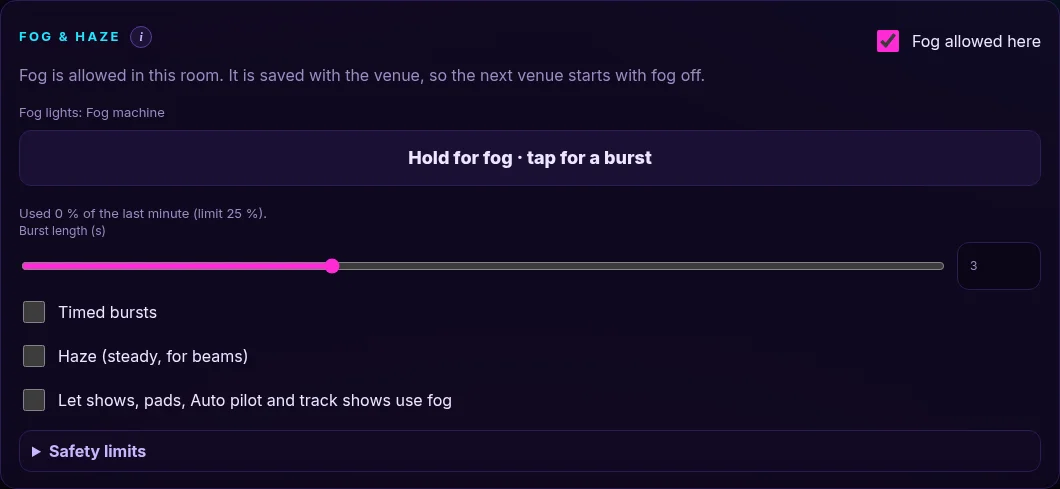
- Fog can set off smoke alarms. Always ask the venue first.
- Add a fog machine or hazer in Fixtures (Generic fog machine or Generic hazer).
- Open Fog & haze and turn on Fog allowed here. It is saved for this venue only, so the next venue starts with fog off.
- Hold the big button for fog, or tap it for a short burst. Safety limits stop bursts that are too long and too much fog in any minute.
- Shows, pads and Auto pilot only use fog if you allow it and turn on Let shows use fog.
Step 6: Sync the Lights to Your Music
- Listen: no DJ software link needed. The app can listen through the mic and follow the beat.
- Pioneer DJ Link: the helper listens on your network for CDJs and XDJs, shows each deck’s BPM, beat, phrase and time left, and the lights lock to the master deck.
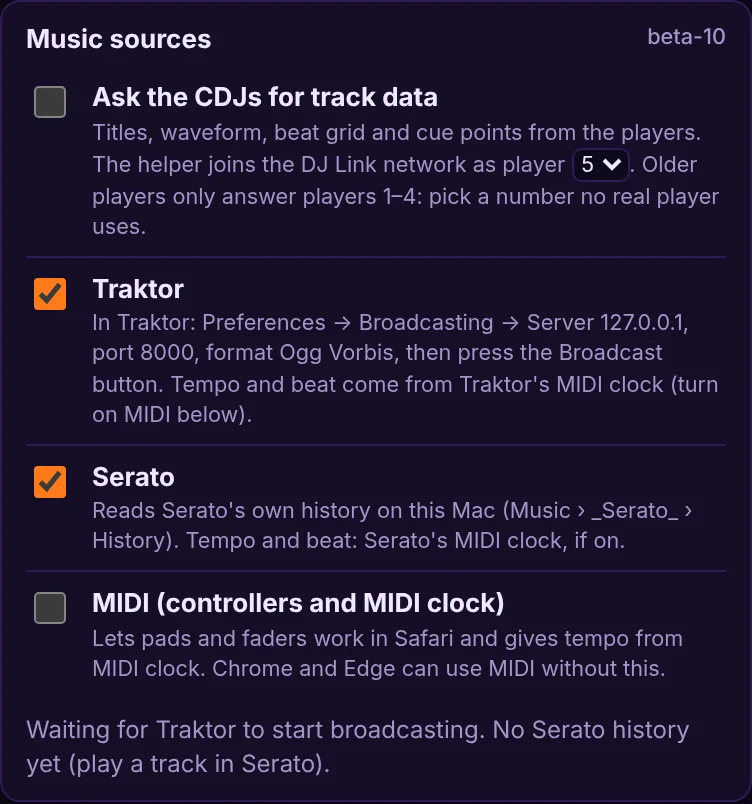
- Serato and Traktor: turn them on in the helper under Music sources. Serato is read from its history on your Mac. For Traktor, follow the steps shown in the helper. Tempo can also come from MIDI clock.
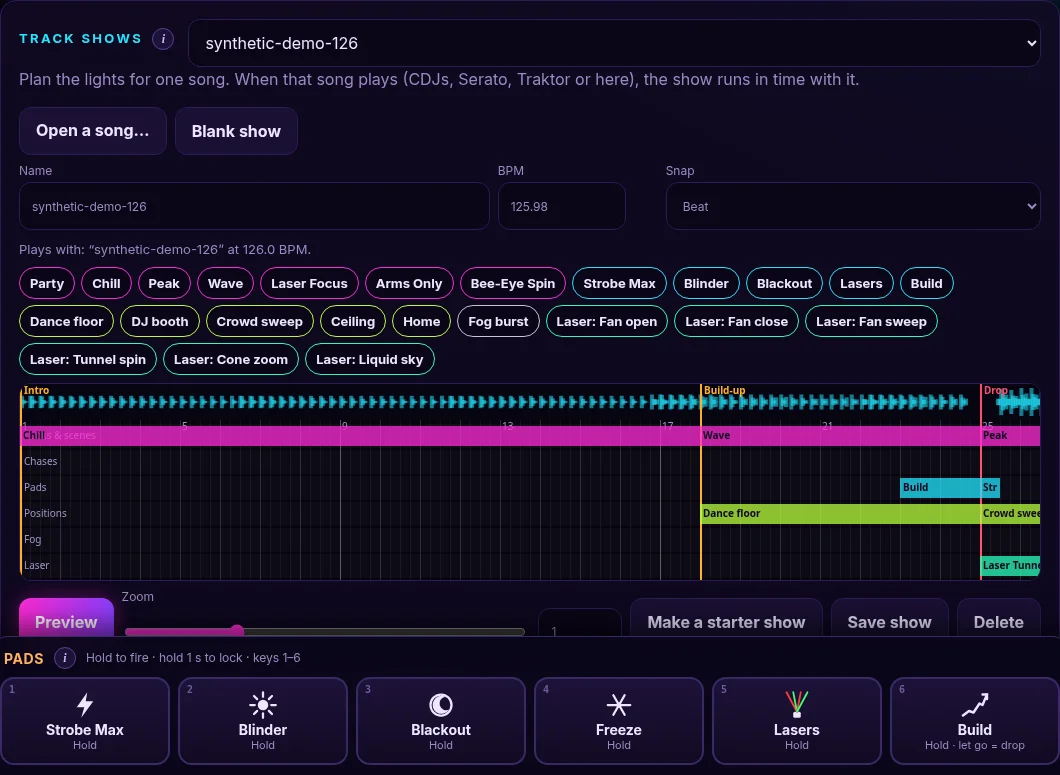
- Track shows: open a song, tap Make a starter show, and the lights play in time when that song plays on a DJ Link deck or in Serato or Traktor.
Step 7: Use the Phone View and Remote
- In the helper, turn on Live view. Scan the QR code with your phone and type the PIN.
- The phone shows each deck: BPM, counters, time left, waveform and the next songs.
- For a remote, turn on Allow control from the phone. It has its own control PIN.
- The phone can fire pads, scenes, Blackout, Auto pilot and LASER OFF. It can never arm a laser or use fog.
Prefer real buttons? Open Remote & MIDI, tap Learn next to an action and press a pad on your MIDI controller, or copy a link from the helper into a Stream Deck Website button.
Tips for a Smooth First Gig
- Set and write down every light’s address and channel mode before the gig, not on site. Overlapping addresses are the most common reason a light misbehaves.
- Plug the DMX cable into DMX IN on the first light, and make sure each light is in DMX mode.
- Run the demo and a full song at home with your real lights before the guests arrive. The app is in beta.
- Tap Show file → Export to back up your lights, stage, scenes, looks, night plans and shows to one file, and Import it on another Mac.
- Each venue keeps its own room and fog setting, so you can save the rooms you play often.
FAQ
Do I need internet at the gig?
No. Once opened, the app is saved on the device, and the helper has its own copy.
My lights don’t react. What should I check?
Check the helper says Connected and the DMX interface is found. Check the DMX cable goes into DMX IN on the first light, and that the light is in DMX mode.
One light does the wrong thing.
Its DMX address or channel mode doesn’t match. Look at the light’s own display and set the same in Fixtures.
The Mac won’t open the helper.
Go to System Settings → Privacy & Security → Open Anyway. You only do it once.
The helper can’t find my EasyNode.
Allow local network access for the helper, and make sure the Mac and the EasyNode are on the same Wi-Fi.
Can a remote or my phone turn on a laser?
No. Lasers can only be armed on the DMX Flashback Events screen. Remotes can only switch them off.
Fog doesn’t fire.
Turn on Fog allowed here for this venue. For shows and pads, also turn on Let shows use fog. A short rest between bursts is normal.
Is my music sent anywhere?
No. Songs you open for Track shows are analyzed on your computer, and your rekordbox library stays on your Mac.
Flashback Lights That Are Ready to Go
These lights are built into the app, so you only pick the model and channel mode and set the address:
- 150W 6-Arm Moving Head DJ Light with LED Halo (built in as the 6-Arm Hybrid, 26CH mode)
- 150W 6-Arm Moving Head DJ Light (built in as the 6-Arm Hybrid, 24CH mode)
- 120W 6 Arm Moving Head DJ Light, Disco Ball Effect (built in as the 6-Arm Abyss Hybrid)
- 120W Beam Moving Head DJ Light (built in as the Moving Head 441)
- 6 Bee Eye Moving Head DJ Light (built in as the Bee-Eye 6×15)
Planning a full rig? Our Mobile DJ Lighting Setup Guide covers portable rigs, and our 500W fog machine helps beams show up in the air.
Good to know: DMX Flashback Events is in beta. Test your show with your own lights before the guests arrive. The full step-by-step help lives in the DMX Flashback Events guide.
Start Your First Show
The app is free during the beta. Open it, try the demo, then add your lights one step at a time. Stuck? The guide has every screen in short steps, and the Feedback button in the app goes straight to our team. To see everything the app can do, read Meet DMX Flashback Events.
Follow along for light shows, mixes and app updates: Instagram @dancepartylights, TikTok @yourpartylighting, and YouTube Flashback Events.
